Brothers (& Sisters) Killed in Action in USMC Helicopters or while assigned to USMC Helicopter or Tiltrotor Squadrons
19750429HMM-164 USMC RESERVE INCIDENT/ACCIDENTS
Download PDFIncident Date 19750429 HMM-164 CH-46D 154042+ - Crash at Sea
Nystul, William Craig Capt Pilot HMM-164 USS Hancock - SAR 1975-04-29 (vvm 01W:124)
Shea, Michael John 1stLT Co-Pilot HMM-164 USS Hancock - SAR 1975-04-29 (vvm 01W:124)
Personal Narrative
The last Marine Helo lost in Nam was YT-14 from 164, on 04-29-75. I would have to agree that in most cases no-one wants to be the last. There is another last to 164's history, that of the two Pilots KIA at 11:30 P.M. on 04-29-75.I should know, I was the crew-chief of YT-14 when it went in. Capt. Nystul and 1stLt Shea were the last Marines KIA in VN. Last Squadron, last CH-46 lost, last Marines injured, last Marines KIA.
Submitted by: Stephen R. Wills, HMM-164, YT-14 crewchief, 20030801Personal Narrative
This CH-46 was lost at sea during the night of 29-30 April 1975 during Operation Frequent Wind...the evacuation of the Saigon Embassy. To my knowledge (I was there), the loss of our SAR A/C flying "Angel" for the USS Hancock accounted for the final Marine casualties of the Vietnam era. Since that operation ended in the early hours of the morning of the 30th with the extraction of our Ambassador, so did all US involvement with VN. Actually, there was a final CH-46 flight to the Embassy rooftop to extract the remnants of the security force still there, and quite frankly almost overlooked in the chaos of the lengthy evacuation.
It was late on the night of the 29th and well into the operation when the CH-46 SAR helicopter crashed into the South China Sea along side of the Hancock. It was tragic to say the least. Both the pilot, Capt. Bill Nystul and co-pilot 1stLt Mike Shea were lost at sea. The other 2 enlisted crewman were rescued (that in itself involved tremendous heroism on the part of Capt Steve Haley and 1stLt Dean Koontz breaking off on deck refueling and executing a night water landing and taxiing around to pickup the 2 survivors). The tragedy is that Bill was a new WestPac arrival to Okinawa when we deployed with all the remaining H-46's and UH-1E's from Futenma. He had just completed schooling and was re-famming in the 46. Mike, as I remember, was a CH-53 co-pilot. This is the combination that was orbiting the ship for 4-5 hours and was coming aboard to refuel and launch again!
The final approach was waved off, and on downwind (pitch black) they flew into the water with no apparent awareness that it was happening. They did not make any distress call or respond to frantic calls from pri-fly!! The next evening we held the traditional burial at sea service without recovering the remains. The crash site was located in 65 feet of water, but because or the immense political pressures to vacate the area, no attempt for recovery was made. I am positive, according to the time schedule I alluded to, that these 2 Marines were the final casualties.
Personal Narrative
I was there - standing with another Crew Chief on the deck of the USS Hancock after flying for about 14 hours on or about 11:30H 29 April 1975.
I saw Scott or Wills penflares hit the sky over Saigon Harbor from the deck of the USS Hancock. I watched the pilots fire up the helo that landed in the water and rescued Scott and Wills. It was the most intense moment of a very long day.
Personal Narrative
I was on deck, and saw it all.. It was a very sad thing to watch, but it was the most "Heroic" thing I will ever see. When they cranked the engine up to pull out of the water, (we thought they weren't going to get out) and landed on deck and all the water poured out of the bird and the pilots were wet. And the rescue of the crew. Yes, they all deserve a medal.
"YT-14 - The Last Marine Helicopter Lost in Vietnam"
At 06:00 on the morning of 29 April 1975, the Boeing Vertol CH-46D SeaKnight YT-14 prepared to launch as the overwater SAR (search and rescue) aircraft from the carrier USS Hancock (CVA-19) for Operation Frequent Wind, the evacuation of American and Vietnamese personnel from the American Embassy in Saigon. Normally, a fixed wing carrier such as the Hancock executing helicopter operations would not launch a helicopter SAR aircraft as any helicopter could perform SAR duties. However for an operation of this magnitude, a designated rescue helicopter provided the task force with the capability of responding instantly to any emergency.
This was a special day however, because of the air traffic potential. Emergency USMC helicopter operations were planned all day as necessary for the evacuation as the North Vietnamese Army entered Saigon. Much of the air traffic would be of South Vietnamese origin, as had been witnessed the previous day. Vietnamese helicopters and fixed wing were expected to arrive at any time. Some Vietnamese pilots, with their families and friends attempting to escape South Vietnam, ditched adjacent to the shipping, while others attempted to land on the various decks, some on top of other aircraft. There were many times during the day that the decks of various ships were fouled with aircraft, sometimes intentionally, including both helicopters and fixed wing. YT-14 was designated the Angel Flight (Naval term for overwater SAR) for operation Frequent Wind, to be used for any eventuality.
YT was the designation given to all aircraft assigned to Marine helicopter squadron HMM-164. Cpl. Stephen R. Wills was the Crewchief/Right Gunner of YT-14, an aircraft affectionately known to the Marines who flew it as a Phrog. Cpl. Richard L. Scott was his 1st Mechanic/Left Gunner for this early-morning SAR mission. The aircraft and these men were assigned to Marine Medium Helicopter Squadron 164. The two Marines remained with their aircraft in orbit over the South China Sea through the entire day and into the night, for 17 hours, refueling every couple of hours, without shutting down.
According to Steve Wills, throughout the day during several hot refuelings on the deck of the USS Hancock, Vietnamese aircraft were “trying to land on top of us.” “Conversations during the day between crew members aboard YT-14 were strictly that of Marines carrying out their routine duties, and wishing they were someplace else.”
As the day advanced, at approximately 13:00, during a hot refueling, Capt. William C. Nystul and 1stLt. Michael J. Shea relieved the originally assigned pilot and copilot aboard YT-14. Bill Nystul was a recent WestPac [Marine operating area – western Pacific] arrival to Okinawa when HMM-164 deployed with the remaining UH-46D’s and UH-1E’s from MCAS Futenma, Okinawa. He had just completed schooling, and had re-fammed in the H-46. Bill had been a fixed wing instructor in the Naval Aviation Training Command at Pensacola, and had since accumulated approximately 20 hours of refamiliarization time on the CH-46. Mike Shea had accumulated approximately 25 CH-46 hours in Futenma before deploying, and was previously a designated CH-53 pilot (7564).
Capt. Chic Schoener was assigned to H&MS-36 as a pilot in Okinawa and did his CH-46 flying with both HMM-164 and HMM-165. He remembers giving Bill Nystul an Okinawa island Fam hop before they embarked aboard the aircraft carrier USS Midway (CVA-41) for cross decking to the USS Hancock and had known both he and Mike Shea before and while embarked. Chic, like many other squadron pilots, flew 13 or more hours during this day.
“A typical CH-46D carried 2400 lbs. of jet fuel (JP-4 or 5)(1200 in each stub wing) and had a routine flight endurance of 2 hours. Under certain flight conditions that time could be stretched to 2+15 hours. However, NATOPS and safety dictated refueling when the fuel quantity was no lower than 200 lbs per side (approximately 20 minutes fuel remaining). The fuel “low caution lights” usually came on with 340 lbs of fuel remaining. This operation was not routine (by any standards) with many aircraft and crewmembers' limitations being stretched well beyond stated limits. Extraordinary times call for extraordinary efforts.”
According to Steve Wills, maintaining the SAR orbit was not simply a “watch.” The crew had been active all day with various tasks.
“I would just be guessing as to the number of times that we refueled that day. But it would have to have been six or seven times, maybe even more. On one of our landings to refuel, we were loaded with about twenty or so refugees that were to be transferred to the USS Blue Ridge (LCC 19).”
“Just as we landed on the Blue Ridge, we were told to launch immediately, as there was a small aircraft that had crashed aft of the Blue Ridge. We off loaded our passengers, took off and CPL Scott and I readied the rescue hoist, and opened the hellhole. We spotted three personnel in the water and lowered the hoist. It was very evident that two of the people where in bad shape with what looked to be massive head injuries. All three of them tried to get in the hoist, as they were only a few feet apart from each other. The one that wasn't hurt got in.
“We started to bring him up, when I saw that one of the injured men slipped under the water. I told Capt. Nystul to back off as our rotor wash was pushing them under. I told Captain Nystul that I was going to go into the water to try to help the other man. He told me to send in Scott. I informed him that Scott couldn’t swim. By the time we got the first man in, we lost sight of the last man. We started to circle to see if we could find the third man but couldn’t find him. A small Navy launch from the Blue Ridge was now on site, and we were released to return to the Hancock to refuel, and return to our SAR orbit point.”
“During this mission there was a Navy officer on board taking pictures of the rescue … I had to keep pushing him away from me, as he kept getting in my way while we were trying to rescue those downed men.”
The weight of the helicopter and the temperature of the day had significant effects on the operation that day.
“Twice we had to dump fuel because of our weight. After we departed the USS Hancock we where losing altitude due to our weight and the heat of the day. Capt. Nystul told me that he was going to dump fuel. I informed him that there should be no problem with the system, as I had personally checked it out a few days before. “That’s what we heard” was the comeback from Capt. Nystul.”
“Several days before the evac, I pre-flighted YT-14 for a test flight after replacing the rotor pitch-change link bearings. The flight was to take place later in the afternoon. After going down to the maintenance office, I was told that the test flight would take place in about 20 minutes. I was told to have YT-14 spotted and to unfold the blades.”
“We had the deck crew spot her on the #1 spot. I got in and fired up the aircraft APP [auxiliary power plant] and when I brought the electrical power on line, I switched it from DC current to AC current. Right then the ship’s deck came alive with people trying to get me to shut down the aircraft. My 1st Mech, Cpl. Scott came in yelling that we were dumping fuel on the flight deck. I reached up and hit the APP switch to shut it off. Still we were dumping fuel. I told Cpl. Scott to go back and put his hand over one of the dump pipes and to have one of the other mechanics out side do the same to the other side. I guess you could imagine the double hand gestures I received.”
“I looked up and saw that the fuel jettison switch was in the open position. I fired the APP back up, reached up and moved it back to the closed position, flipped the APP off. Still, we were dumping fuel. Then it came to me that I didn't bring the electrical system on line with the AC current.”
“Again I fired the APP up, only this time when she lit off - there was a ball of flame that shot out the back at least ten or fifteen feet from the APP. I could see people running everywhere away from the A/C. I switched the system to AC and toggled the switch, shut down the APP, and vacated the A/C.”
“By then, the crash crew was there. Needless to say, I was asked to go visit the CO and the ships Captain. That’s why I told Capt. Nystul I knew that the system worked.”
The second time they had to dump fuel was when a Marine CH-53 was losing altitude. It had over 30 people in it and they feared that it was going to go in.
“We were vectored to its location and could see that she was dropping and at the same time dumping fuel. We dropped half or more of our fuel as we knew that there was no way we could maintain altitude while trying to hover if we were to try and rescue any survivors. The H-53 couldn't have been more than a hundred feet off the deck. This was during the hottest part of the day. Thankfully it started to gain its altitude back and we were not needed.”
The day had progressed to evening. The Ambassador still refused to leave Saigon. It was dark and it was getting later. All crews were pushing their safe flight time limits. Twice in the final hour of their SAR flight they were on final approach to the USS Hancock when they were sent back out to their orbit point for another possible mission. They were to report when they were down to 30 minutes fuel remaining. The fatigued pilots on the flight crew had been flying continuously for ten hours and the aircrew had been working continuously for seventeen hours when, in Steve Wills’ own words, the following happened:
“We were at our orbit point when Capt. Nystul radioed for clearance for a landing approach back to the USS Hancock. We were down to about 30 minutes of fuel. We were given the OK to return, refuel and then go back out.”
“On our inbound approach, I looked out the rear of the ship and saw a light at our 6 o’clock position coming in on us. I made it out to be another aircraft. I told the Captain and I then cleared him for a hard right turn. That other aircraft missed hitting us by less than 100 ft.
“For the next 15 minutes there was no conversation in our aircraft, except for a comment made by Captain Nystul that "Some one is going to die up here tonight."
“On returning to the ship I was asked if we were clear for a left turn. I gave the OK and no sooner than that, I heard “Pick it up, Pick it up, Pick it up.” I did not hear “Pull-up” as was stated in the KIA incident report. I braced myself, thinking that we were about to be in a mid-air with another aircraft. That day we must have had five or six close calls with other aircraft; not those of the Marines but of the Vietnamese.”
“I don't remember any sudden descent or that of pulling in power. The only thing I remember was that of the hard landing lights coming on. That's when every thing went black.”
Concurrently Sgt. Chris Woods, Crew Chief of Swift 22 aboard the USS Hancock witnessed the following:
“The traffic pattern around the Hancock was very congested with aircraft landing, dropping off passengers, refueling, etc. Helicopters were continuously landing and taking off. Swift 22 had been refueled and stashed behind the [carrier] island to free up landing spots.”
“I can't remember if I was doing a turnaround inspection or trying to get some rest. “ PULL UP, PULL UP, PULL UP” the air boss said over the 5MC (flight deck) speakers. The air boss kept yelling "PULL UP" until the aircraft impacted the water. I ran out in front of my aircraft to see a left running light (red) angling towards the water, it continued until there was "flash" caused by the aircraft impacting the water. I remember hearing several helicopters hovering trying to pick up survivors. Pandemonium was everywhere.
There had been an immediate response from the personnel aboard the Hancock aware of the distressing situation. There were at least four helicopters that made attempts to get the survivors out; two Navy rescue SH-3's, one Marine CH-53 and finally another CH-46. Cpl. Wills related:
“I came to under water. That’s when the Water Survival Training took over. I was only able to inflate one side of my LPA. The right side of it was torn. When I hit the surface I found that my radio was gone, along with my pistol. I found my pen flares and fired two of them. I started yelling to see if any one else got out. Cpl. Scott yelled back. He was about fifty yards from me.”
“Cpl Scott was yelling that he couldn't swim. I was yelling back to him, to pop his LPA and finally he did. We both tried to get to each other, but the current was pulling him farther from me. I couldn’t move because my right hip was dislocated, and my left leg had a compound fracture 8" above the knee.”
“The first two Navy SH-3’s tried to get us out with their hoist, but we couldn’t hook up. The rotor wash from the CH-53 that came over us just kept pushing us under the water. The two SH-3's and the H-53 tried to drown me and then backed off.”
“After firing my pen flares, I was able to light up my strobe light. I do remember that Scotty fired his pen flare at the first or second helicopter almost hitting it. I yelled to him to get his strobe out and light it up. That would have been the only way that he could be seen.”
Another CH-46D, call sign Swift 07, from HMM-164 was on the deck of the USS Hancock undergoing hot refueling, piloted by Capt. Steve Haley and 1stLt. Dean Koontz. They launched immediately, and picked up Cpl. Richard Scott by hoist. They completed a water-landing at night near the crash scene in pitch-black conditions and water-taxied up to the struggling and seriously injured Cpl. Wills. He was unable to get into the rescue harness due to his injuries.
“In all of our training we were told that PHROGS don't float. But I can sure tell you of the one that can swim.”
“When the rescue aircraft tried to get me out, and when being pushed under water by the rotor wash, I remember covering my strobe light so they couldn't see me. They would then have to back off, letting me come back to the surface. I did that more than one time. I was blacking out from loss of blood and shock when I came to and saw those rotor blades over my head.”
“There was seawater in the cabin section [of Swift 07] when they pulled me by hand thru the cabin door of the CH-46. I heard the emergency throttles come up and remember the whine of the engines and the slapping of the blades ... I still can look up and see the rotor blades and thinking that H-46 was crashing on top of me.”
“The hand that reached out to me was that of the rescue aircraft Crewchief, Sgt. Lon Chaney … we spent approximately 45 minutes in the water before they got us out.”
Continuing the account of the rescue as witnessed by Chris Woods on the deck of the USS Hancock:
“Then all of a sudden I watched as the bottom anti-collision light on a Phrog went underwater. I thought, GOD, not another crash. I watched as I realized that the aircraft was in the water to pick up survivors. Moments later Swift 07 was on the flight deck with Cpl Stephen R. Wills and Cpl Richard L. Scott. Capt. Nystul and Lt. Shea went down with the aircraft. The mood was not good. Everyone was exhausted and now we had to accept the deaths of two squadron mates.”
The rescue was completed at about 23:30 on 29 Apr 1975. The bodies of Capt. Nystul and Lt. Shea were never recovered. Estimates from the ship were that they were in 65-100 feet of water [the ship had been moving all day]. The only items that were found after the incident were the four flight crew helmets and the front landing strut with the tires on it.
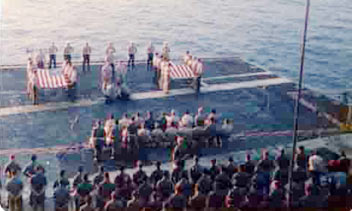
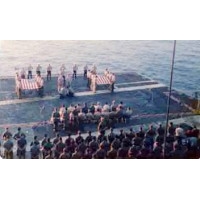
At twilight on 30 Apr 1975, a very moving and traditional Burial at Sea was conducted for Capt. Bill Nystul and 1stLt. Mike Shea aboard the USS Hancock. They escorted one of the surviving crewmembers, Cpl. Richard Scott, across the deck for the Memorial Service. Cpl. Steve Wills was resting in double traction of both left and right legs on the 03 level of the ship and could not be moved. He was later very appreciative of the aircrew members for dropping in on him during his recovery.
“If it were up to me, Capt. Haley and Lt Koontz would have received the CMH. But in saying that, please don't forget the hand that reached out, with seawater flowing in the cabin section, pulling me in … not with the hoist but by his hand. The aircrew of that ship will always live in my heart and mind as my guardian angel, even though I was flying the Angel Flight.”
Operation Frequent Wind ended on the morning of the 30th of April with the extraction of Ambassador Graham Martin, followed by the extraction of the Marine Security Detachment, as did all U.S. involvement in the Republic of Vietnam.
YT-14 (BuNo 154042) of HMM-164 was the last Marine helicopter lost in Vietnam, and still sits at the bottom of the South China Sea in 65 - 100 feet of water at coordinates N 09 55’ 32” E 107 20’ 06”, or at approximately 30 nautical miles on the 150 o radial of the Vung Tau NDB.
“One last thought. If we know approximately where YT-14 lies, why couldn't there be an attempt to see if there are any remains. With today’s technologies, it might be a simple operation. We dig up mountains at crash sites to find remains no matter how small. To bring back the remains of the last two American service men, the last two Marines, to have been killed in action in Vietnam would mean a lot.” Cpl. Steve Wills, USMCR (medret)
I am a former CH-46 pilot from HMM-164, and served with the squadron in 1972. I am presently affiliated with the aircraft naming committee at Patriots Point museum, Mt. Pleasant, SC, which houses not only the USS Yorktown, but also the Vietnam Experience, an exhibit that showcases aircraft and equipment from that conflict.
Three years ago we acquired a CH-46, BUNO 154009, which bears the markings of HMM-164. We will be placing the names of Captain Nystul, and 1stLt Shea, on it, in the spring of 2019, as a living memorial to the last pilots killed in the conflict.
If you would be interested in attending, or have a way of contacting living family members, please forward me your contact info. A firm date has not been picked as of this time.
Personal Narrative
Bill Nystul was a highschool classmate of mine at Coronado HS. A gentler and nicer guy you will never know.
Submitted by: Patti McKenna Witalis, LTC, SP, USAR, highschool classmate, 20050429Personal Recollection
My family moved to Coronado in 1957, to a new house built in a small development of homes on the west end of Ocean Boulevard, across the street from the rock seawall and beach. As additional homes were built, I met the Nystul family who had moved into their new home just 3 houses away.
Bill and I were the same age, and soon became best friends, spending much time at the beach while learning to surf on our old balsa wood boards. Coronado was a quiet beach town in those days, with its Ferry boat access (before the bridge was built), and we'd often have the beach to ourselves as we teamed up to carry the heavy boards down to the water. We were classmates in school, and our families became well acquainted as we spent time visiting, studying together and collaborating on homework projects.
There's one day I'll always remember from 1959 or 1960. It was mid afternoon, and I was in my house changing clothes for the beach when I heard a loud BAM! BAM! BAM! from across the street, on the beach. I got dressed as fast as I could, went outside and climbed the rocks to see what had happened. There, just on the other side of the rocks, an old F4U Corsair had crashed on the beach. The plane had a broken appearance where its huge engine had been torn from its mounts, and folded underneath the fuselage. Bill had been on the beach when this happened, noticed that the pilot was having some difficulty escaping from the plane after the crash, and jumped up onto the wing to try to help him out. As I watched, and continued across the rocks toward the plane, Bill jumped down from the wing and moments later flames began rising from the engine, rapidly growing with a huge plume of black smoke. Crash trucks were on their way from NAS North Island, but were delayed since they had to smash down the Navy fence to reach the crash site. As they made their way across the beach, a helicopter arrived, hovering to fan the flames away from the pilot. Finally, the crash crews were able to extinguish the fire, though the pilot would later die from his injuries.
Talking with Bill about this, I remember him saying that he'd been on the beach at the time of the crash. As the plane came to a stop, he gone to the plane to see if he might help the pilot get out of the cockpit. He'd run and jumped onto the wing, but the impact of the crash had pulled the instrument panel down onto the pilot's knees and had him trapped. The pilot told Bill that he likely had lost a lot of blood from his injuries. Bill stayed on the wing with the pilot as long as he could stand the heat of the metal under his bare feet. This was Bill; he'd not thought about his own safety when he jumped onto that wing, just that it was the right thing to do - his concern was only about the pilot needing help.
Through high school we were teammates in wrestling and football. Away from school we spent time surfing, learning to play guitar, and working on cars. Bill had many friends in school, and he was a great friend to have: dependable, always ready to help, always ready to go out of his way when needed.
It was sometime in 1970, after finishing USNA and flight school I'd just moved back to Coronado, married, and was stationed at NAS North Island. Bill and Carol came to visit, I think he was on his way to flight instructing at Whiting. Getting caught up on some years, he'd gotten his wings about a year ahead of me. We'd both been thru the same basic flight training, though he'd gone off to primary props and advanced helos whereas I'd gone thru primary and advanced jets. With the war demands in the late '60's, the Naval training command had geared up to full capacity; students and instructors were flying at least 6 (usually 7) days a week. Comparing flying experiences we'd had in military training, we talked about close calls, emergencies, lost friends. We'd both lost a number of fellow students going thru the training. It was a tough course; so many accidents, so many flukes and mishaps. After a certain point, many aviators take on the opinion that pretty much anything can happen at any time; that danger always surrounds us; that we'd best make the most of life while we can. We both shared that view.
As I write this [Sept 2011], it's been a bit over 36 years since Bill's crash. Just a few weeks ago I sat in the backyard of the Nystul's home in Coronado, meeting in a mini-reunion with 2 of Bill's brothers, Mike and Steve. We'd not seen each other for some years, and had a couple hours to spend there, in a place not so much changed since the '60's, a well-cared-for patio where we'd all spent so many happy times. Steve had some unfortunate news about the death of one of our old neighborhood friends, Tom Sanders. In talking about Tom, we recalled a story he'd told us back in the early '80's. As Tom described it, he'd been evacuated as an Army green beret that last day of the war, and had witnessed the crash of Bill's helicopter. According to Tom, the helo (apparently a UH-1E) was carrying a load of evacuees who were hanging onto the skids underneath the aircraft. Suddenly, as the huey flew low over the water, everyone hanging onto one of the skids let go, while those on the opposite skid hung on. This imbalance then caused the helo to bank suddenly, and impact the water before the pilot could recover control. The story seemed to match with some of the crash scenes from the old tv coverage, and with Tom's insistence (and nothing else to go on) this was what I'd thought had happened. Mike disagreed, saying he'd heard that Bill's helicopter, unable to land due to crowded conditions had run out of fuel. We also talked about old times we'd spent with Bill - memories that each of us had.
I'm reminded of a conversation I had with my mother, regarding losing dear friends. She'd lost 2 of her 4 brothers in World War II. She told me that there are some losses that you just never get over. This would be one of those for me. But, adding to her words, I feel like losing someone close to us awakens something within our beings that make us more like those who we lost. We find ourselves saying things that they would have said, or expressing feelings that we know they would have had. So, visiting with the Nystul family very much brings back a presence of Bill for me, whether we're talking about him or not. Something like the essence of music, as they say, being not so much the notes, but the pauses between them.
There's a saying that I'm sure every aviator who's flown at night has heard: "black air has less lift". Not exactly true, of course, but it describes that bit of spooky uneasiness that every pilot feels when flying at night. So much about flying is a visual experience that piloting aircraft at night is much different, more stressful, and requires more concentration, especially when splitting attention between a dimly lit cockpit and a dark world outside.
Until reading the description of this crash by the flight crew, I'd thought of it as having happened in daylight. Now, this fuller description of the circumstances brings it into more perspective. Still, there are questions, especially regarding that final left turn. Was there a wave-off? Yet another blacked-out and panicked South Vietnamese chopper to deal with? I guess we'll never really know. What we do know, though, is that Bill and his crew on YT-14's Angel flight were out there tirelessly on that day and night, far past even the demanding endurance limits set for military pilots, in extreme circumstances, and were heroically saving lives. Bill would have been proud of his crew and what they did that day. I'm proud to have known him.
Personal Recollection
During my 1966-67 junior year at Burges High School in El Paso, Texas, Mike Shea and I used to spend lunch hours together with our girlfriends, Thelma Alessio (Mike) and Jennifer Oseau (mine), off campus at a local 7-11 type store ... we'd just hob-nob and eat our munchies ... I thought Mike had enlisted at the end of that 1966-67 school year, as Thelma and Mike stopped seeing each other by then.
I halfway recall that Mike went to another area high school for graduation and left Burges, or perhaps was dating Thelma even though he did not actually attend Burges ... my brain cramps up on that one ... we double dated a few time, once sneaking Jennifer and me in the trunk of Mike's sedan into the drive-in at east Montana street that was then on the very outskirts of El Paso ... I never saw Mike again after that junior year and found out about his death when I was visiting El Paso during the late summer of 1975 ... I was riding a city bus home from downtown and ran into another schoolmate from Burges (wish I could remember who that was) and he told me about Mike.
It hit me pretty hard, as Mike was the type of guy that you always remember ... yeah, he was the proverbial tall, dark, and handsome guy that girls squealed over, but he was also a considerate and kind person with a wicked good sense of humor ... I can understand why his buds in the Corps thought the world of him ... I remember when I found out about Mike on that bus that he was already known as one of the very last from the services to die in Viet Nam .. now I understand that both pilots on that tragic flight actually were the very last 2 to die for us in Viet Nam ... after 35 years, I still remember Mike and our times together, however brief they were in the Big Picture of Things ... he was a unique friend that you just don't let the memory of die ... Semper Fi and God Bless ...
Personal Recollection
I knew Capt. Nystul when was an instructor pilot in the early 70's with HT-18 at Ellyson Field, Pensacola, Florida. He was a fine officer and gentleman. We attended the same church and I was able to meet his wife and small daughter. They are often on my prayer list after all these years.
My rating was AK2 (AC). I had the privlege of flying with him a few times as his crew chief in the TH-1L and UH-1E. Capt. Nystul struck the perfect balance between an officer and his realtionship with the enlisted Navy maintenance troops. He always had a good story and word of encouragement while checking out a flight packet for cross country instument flights.
I did not learn of his death until a TV special aired in 1985. It was a shock to say the least. I was able to do an etching of his name at the Memorial Wall on a business trip in 1987.
Associated Information
Mother's day 12 May 1968: the Special Forces Camp at Kham Duc was being evacuated on a very hostile day. The YT-14 a/c piloted by Capt James T. Butler (aka Smedley) and co pilot Al Frisenda with David Plowman as Crew Chief picked up a squad of men from "D" Co 2/1 near the end of the evac late in afternoon. They had been sent to the SW end of runway in an engineer piling to make sure the NVA did not charge up Rte 14 onto the runway.
In the chaos of the evac, they being good troopers, stayed at their post, alone, far from nearest US units, as most everyone was being airlifted out (they had no radio).
As YT-14 flight of 3 or 4 A/C looked for anyone to pick up on the runway, the squad of "D" Co was spotted pretty far from the few remaining good guys. YT-14 landed at the SW end of runway and the elated squad was rescued. YT-14 had been dropping sensors along HCM [Ho Chi Minh] trail when they got the call to go to Kham Duc.
NOTE: I was not aware of the 1975 story of YT-14.
NOTE: Col Joe Jackson, USAF earned MOH [Medal of Honor] by picking up 3 CCT and mistakenly returned to Kham Duc after camp was empty of good guys.
Burial at Sea - Capt NYSTUL and 1stLt SHEA
http://www.virtualwall.org/ds/SheaMJ01a.htm
Personal Recollection
I was an E-5 working H&MS-16, Futema, Okinawa in 1974. I had been directed to be prepared for an operation to Mindoro in the Philippines (MAFLEX). In March, 1975, I was suddenly transferred to HMM-165 (White Knights), and the squadron was preparing to deploy for a mission to South Vietnam.
As I checked into the squadron, I had to get a brief from 1st Lt. Mike Shea. I was really impressed with him. As I recall, he was eating something when I talked to him – I think it was a banana – and he did get a smile out of me during the lecture more than once. He was tall, lanky, dark-haired, and admonished me to keep my parents informed as to my well-being. I would say he was one of the most well-liked officers in the squadron. I have no idea how long he had been in 165 at that point.
The squadron was deployed aboard LPD-8, the USS Dubuque. It was an odd setup on board as the sister squadron, HMM-164 was split-up and attached as well, and we ended up with (as I recall) one or two of 164's birds on our boat. I was assigned flying duty as a door gunner on board YW-15, at least I think that was the number. It’s been while. Later in the mission, the USS Blue Ridge showed up and later came the USS Hancock. The other part of 165 was deployed on the Hancock.
Until I stumbled onto this website last year, I was unaware that Lt. Shea was transferred to HMM-164. The big mystery to us on the Dubuque was who the Crew Chief and Mech were. We didn’t know the names and now I know why – they were 164 guys. We had heard that they somehow got out of the bird when it went in and we were amazed. The odds of anyone getting out of that situation at night seemed a miracle, to say the least.
As the evacuation of Saigon started, the USS Dubuque got underway (after two near-collisions in a thunderstorm with other ships and tossing one RVN UH-1 overboard) and headed South-Southwest. We had no idea why we were leaving the scene. We ended up at an island off of Cambodia named Phu Quoc, where we helped escaping RVNs move on to Thailand.
The news of Lt. Shea’s death reached us a couple of days later and it really hit the squadron (HMM-165) very hard. It was incredibly depressing for all of us. We did get a picture of the memorial ceremony that was performed, and as I remember, it was similar to the one posted on this site.
My father passed away in 1995 and was buried at Arlington. I visited the Viet Nam memorial for the first time. I was able to get one of my best friends name copied off the memorial with a piece of graphite and paper (he was an Army Ranger, killed in action, 1970), and I got Lt. Shea’s name as well. Both pieces of paper are personal treasures and neither will be forgotten.
Friends and Family
I was aware of Bill's death but had never read the details. Thank you for this amazing compilation of facts and testimonies. I was stationed in Vung Tau RVN '68-69. Bill was a wonderful classmate and I will remember him with fond memories and the utmost respect.
Submitted by: Walt Collins, USAF Pilot, '67-72, Coronado High School '63 - classmate, 20090208Personal Recollection
Bill Nystul was a year ahead of me at Coronado High School. His younger brother, Mike, was my classmate. My own brother (also named Bill) served as an Army officer in Vietnam.
I remember Bill Nystul as a superstar on the wrestling team along with his younger brother who was an equally accomplished wrestler. My brother was on that team though not nearly as accomplished in the sport.
I would often surf with Bill and Mike Nystul at North Beach in Coronado, California. Bill was as fine a young man as you would ever hope to meet.
Living in Charleston, SC the last 23+ years, I was here when the traveling Vietnam memorial was set up for a short stay at Patriot's Point (a park and military memorial in Mt. Pleasant, SC where I live). I made a special trip to see the wall and see if the name Bill Nystul was there. It was.
Over the years I have often thought of Bill Nystul and his brother Mike and wished that the war could have ended one day earlier.....Bill would still be here.
All these years it has been painful to realize that I knew the last official casualty of the war, and a recurring thought that it could just as easily have been my own brother Bill who might not have returned from the war.
Having lost my own brother Bill at much too young an age, I know the pain his brother Mike and the rest of his family have felt all these years. That kind of pain never really goes away. I've not seen Bill's brother since high school, but perhaps he or some of his family may see this one day and be comforted by the thought that someone else remembers Bill, too. I know I'm not the only one who remembers.
Cpl Steven R. Wills, Obituary
Stephen Ronnie Wills
Mar 26, 2017
KALISPELL – Stephen Ronnie Wills, 65, passed away Tuesday, March 14, 2017, at his home in Kalispell, after a courageous battle with multiple medical conditions.
He was born March 14, 1952, in Missoula to Robert and Vera Wills. He attended Sentinel High School. He had a love for the great outdoors which he enjoyed with his horse Chad camping and riding through the Sapphire Mountains. He was dedicated to the Boy Scout’s earning almost every badge possible. Following in his father’s footsteps Steve’s loyalty, pride and love for his country led him to the Marine Corp in 1970.
On April 29, 1975, Cpl. Stephen R. Wills a helicopter mechanic and crew chief was a victim of a tragic accident. According to an article written, ‘Helo’ Marine Awarded Medal, Cpl. Wills stated, the CH-46 Sea Knight aircraft (Call Sign YT-14) was on final approach to the U.S.S. Hancock and was waived off. The helicopter crew had been flying for almost 14 hours on “search and rescue†detail at this point when the pilot lost his bearings causing the CH-46 Sea Knight to crash into the sea. Cpl. Wills and the first mechanic were the only survivors of the crash. They spent approximately 48 minutes in the water prior to their rescue. Steve sustained broken legs and hip in the accident and spent five months in the hospital. The CH-46 Sea Knight was the last helicopter lost in Vietnam and Cpl. Steve Wills was one of the last two American’s wounded in Vietnam. Cpl. Wills was awarded a single-mission Air Medal for the actions he took earlier that day during Operation "Frequent Wind.â€
Steve returned home to Montana where he worked for the Forest Service, drove truck and worked in sales management. He loved all that Montana offered, an avid hunter and fisherman he spent years enjoying the treasure state. A rugged cowboy by nature he took after the old “Dukeâ€. Steve loved to take drives and knew every road, river, lake and stream. If you were one of the fortunate ones to ride with him you were guaranteed an adventure filled with captivating stories.
Steve had a quiet intelligence, a quick witty humor, he was very generous, and exceptional master grill man and chef. Steve would help anyone the best he could, but he never had much himself. Steve would be the first one there if needed. According to his younger brother the best story about Steve was that everything was bigger than life itself.
Steve's loyalty embraced every fiber of his entire heart and soul for the Marines. In his final years his greatest mission was devoted to Yankee Tango 14 (YT-14). There was not a day that went by in the past 42 years that Steve did not think about the fateful night April 29, 1975. He was passionate about the retrieval of his fallen brothers left behind in Vietnam and the retrieval of YT-14 that still sits at the bottom of the South China Sea; he hoped to see that mission completed before he was called up to his final mission in heaven. His pilot and co-pilot are commemorated on a retired CH-46 Helicopter in the Smithsonian National Air and Space Museum slated to be added to the National Museum of the Marine Corps in the coming years.
Whether you were his spouse, child, grandchild, great grandchild, sibling, friend or family member the ones that knew him and loved him most thought of Steve as a National Treasure. Semper Fi.
Steve is preceded in death by his parents Robert and Vera Wills. He is survived by his spouse Kathy Skillestad of Kalispell, his children Shannon Zimmerman of Missoula, Shane Wills (Heather) of Wasilla, Alaska, Stephen Wills Jr (Alicia) of Minnesota, Brandon Wills of Hawaii and Mardana Wills of Minnesota, several grandchildren, one great grandchild, several nieces and nephews and his siblings Robert Wills (Carlotta) of Missoula and Randy Wills (Lisa) of Florence.
The family would like to give a special thanks to Kathy who dedicated her every being for caring for Steve in his final years. Her devotion and love to Steve’s care will always be forever in our hearts. We also would like to thank Kristi, Laurie and Ryan Waldo for the love and support they gave to Steve during his last years with us.
A memorial service will be held at 2 p.m. Thursday, April 6, at Johnson-Gloschat Funeral Home with a celebration of life following at the VFW in Kalispell. In Steve’s honor, “come as you are.†In lieu of flowers the family suggests donations to Steve’s greatest Mission Yankee Tango 14 (YT-14) yankeetango14.com. Yankee Tango 14 Recovery Project 12725 East Poinsettia Scottsdale, AZ 85259
Submitted by: Leissa Wages, 20170328