Brothers (& Sisters) Killed in Action in USMC Helicopters or while assigned to USMC Helicopter or Tiltrotor Squadrons
19660925HMM-161 USMC RESERVE INCIDENT/ACCIDENTS
Download PDFIncident Date 19660925 HMM-161 UH-34D 148776+ [YR-3] - Artillery Fire, resulting in a/c out of control, crash
Bossman, Peter Robert HM3 Corpsman-Crew HMM-161 HMM-265/MAG-16/1stMAW 1966-09-25 (vvm 11E:012)
Reiter, Dean Wesley 1stLT Co-Pilot HMM-161 MAG-16 1966-09-25 (vvm 11E:017)
Parker Jr., Vernon Howard Cpl Crew HMM-161 MAG-16 1966-09-25 (vvm 11E:016)
Green, Arthur William LCpl Crew HMM-161 MAG-16 1966-09-25 (vvm 11E:014)
Ducat, Phillip Allen Capt Pilot HMM-161 HMM-164/MAG-16/1stMAW 1966-09-25 (vvm 11E:013)
Command Chronology - 3rdBn/12thMarines
Command Chronology - September 1966 - 3rd Battalion, 12th Marines (Rein), 3rd MARDIV
25 SEPTEMBER
At 0650H seventy-two rounds-of 105mm howitzer ammunition were expended as prep fire for the 3d Battalion, 4th Marines in the vicinity of Coordinates YD 007617.
At 0830H Battery “M” silenced VC mortars firing from Coordinates YD 957586 with four rounds of HE quick.
At 1415 Battery ”H” expended one hundred and forty-five rounds of 105mm howitzer ammunition attacking automatic weapons that were firing from Coordinates YD 986613. The mission was fired in support of the 3d Battalion, 4th Marines, and the weapons were silenced.
At approximately 1840H the 1st Battalion, 4th Marines reported receiving enemy mortar fire and started requesting counter-mortar fire. Within the next fifty minutes, four hundred and eighty-six rounds were fired to suppress the mortars. At 1915H a recon observation post reported observing muzzle flashes of NVA/VC mortars and requested permission of the 1st Battalion, 4th Marines to attack the target. Permission was granted, and Battery “G” fired one hundred and fifty rounds of 105mm howitzer ammunition. At approximately 1930H during a repeat fire for effect with eighteen volleys of fire, a flash in the sky was observed after about four volleys had been fired. Immediately, two sets of helicopter lights were seen to turn on, indicating that the flash must have been a third helicopter hit by a round of 105mm howitzer ammunition. Events proved this conclusion to be correct. It was learned that this helicopter was proceeding on a medevac mission for the 2d Battalion, 7th Marines.
Command Chronology - Sept 1966 - HMM-161
25 September 1966.
At 1915, on the 265 degree radial at 12 NM from Dong Ha TACAN, YR 3 was hit by friendly artillery fire. The aircraft burst into flame and was completely out of control at 3,500 feet. The four crewmen were killed together with a corpsman from HMM-265.
Command Chronology - 4th Marine Regmt - Sept 1966
Section VII
Fire Support Coordination and Naval Gunfire
1. Significant Events
"The 3rd Bn, 12th Marines (Rein) remains in direct support of the 4th Marines both in Operation PRAIRIE area and the Phu Bai TAOR [Tactical Area Of Responsibility]. The battalion further has a secondary mission of reinforcing the fires of the 12th Artillery Bn, 1st Infantry Div., ARVN [Army of the Republic of Vietnam]."
2. Problem Areas
"With the displacement of "Landshark Charlie" (DASC)[Direct Air Support Center], SAV-A-PLANE data must be converted to radials and distances and passed to HMM-161 prior to granting clearance to fire. This all takes additional time in the FSCC [Fire Support Coordination Center] and consequently causes more delay in clearing missions. In the part when "Landshark Charlie" was here, clearance could be granted as soon as the standard SAV-A-PLANE data was passed to the DASC."
Personal Narrative
We were engineers at a bridge site with the 7th Marines. We had pulled two wounded engineers from a booby trapped area. A land evac was to pick up wounded – the jeep hit a mine killing driver and wounding me and another from artillery. UH-34 came while sun was going down and was hit by what looked to be rounds from hillside behind our position on Route 9. The chopper was hit in tail section and burned forward - watched crew fall from aircraft on fire. I'm sorry I can't say it any other way but thats what I saw - may they rest in peace.
Submitted by: Russell Kersey, at the site when chopper was hit, 20030803Personal Narrative
The parents of Lt Dean Reiter, copilot, did not have any information regarding the incident other than an initial MIA report from the USMCR immediately after the incident. For many years, they “held hope” that their son would be returned. In 1998, 32 years later, Mr. Reiter contacted the USMC/Vietnam Helicopter Assoc regarding his son. Through our research, contacts, and eye-witness reports of the condition of the aircraft after the incident, it was confirmed to Mr. Reiter’s satisfaction that his son had in fact died in the specified incident; that there was no chance that anyone could have survived the incident and resulting fall or incineration. LT Reiter’s official files with the USMC are registered as KIA, but the family was never notified of this change in status from MIA to KIA. An examination of all personnel files involved in the incident indicates final registration is KIA. Mr. Reiter died the following year after finding out that his son had been lost in the original incident 30+ years earlier; finally with closure.
Submitted by: Alan H Barbour, Historian, USMC Combat Helicopter Association, 20030803Personal Narrative
The H-34 was hit by our own artillery [Btty G/3/12] from Camp Carroll. According to Marion Sturkey's book “Bonnie-Sue,” on page 173 and 174, it was the only documented instance that a Marine helicopter in flight was knocked out of the air by our artillery. In addition, they had made a pick up of one or two WIA's.
We were the chase aircraft [UH-1E]. The [#2 UH-34D] H-34 had just picked up a WIA or two. They [#2] had been down in the zone. They had come out of the zone and were climbing for altitude and [#1] called for a SAV-A-PLANE [a request to the artillery command center for clearance away from artillery fire] and they got one. That is about the time they [#1 UH-34D] took the hit. We were about 75 yards behind them. They were hit in the pilots crew station. The rotor head went one way and the [#1] H-34 went straight down (on fire like a flare).
Comment on Incident
Capt. Phillip A. Ducat was a helicopter pilot assigned to HMM-161, Marine Air Group 16. On September 25, 1966, Ducat was assigned a medical evacuation mission in Quang Tri Province, South Vietnam. His copilot was 1stLt. Dean W. Reiter of the same Marine helicopter squadron and Hospital Corpsman Third Class Peter Robert Bossman, a U.S. Navy Corpsman. (NOTE: According to Navy records, Bossman was assigned to HMM-161, MAG-16.) When the helicopter was approximately 22 miles west of Dong Ha, Quang Tri Province, South Vietnam, the aircraft was hit by ground fire, burst into flames and exploded prior to impact with the ground. The crew aboard was killed, and the intense fire of the crash consumed all remains. Three of the crew of the UH-34 were listed as killed, body not recovered. They perished and cannot be recovered.
Submitted by: John Lane, researcher, 20030803Personal Narrative
I occasionally return to this site to relive my past in Vietnam. I still think of that day and can't get away from it. I had seen plenty of action before this - however, this still haunts me some reason. I know the death of these fine Marines still hurt their families and I feel like I'm part of them. Semper Fidelis
Submitted by: Russ Kersey, witness, 20070317First Hand Witness
I was on Gun 4 as an assistant gunner, shooting counter-mortar fire for 1stBn 4th Marines. 2/7 was also operating almost due north of Arty Hill (later known as Camp Carroll) and may have had a company with us for security.
We had fired 27 rounds per tube and got a repeat fire for affect. As we fired, suddenly a ball of fire appeared in the sky in front of our mission. Everyone started yelling cease fire. 2 or 3 other sets of lights came on immediately behind the copter. Almost everyone with the battery was heartbroken when we learned it was our own copter.
The battery guns were checked for proper elevations and azimuths - all proved we were shooting correctly. It appeared they were inflight from Dong Ha to pick up a WIA. Fire Direction Center and the Exc. Pit of the battery said the copters were supposed to fly behind our gun line but for some reason didn't. They did confirm the WIA was from 2/7 that the copter was flying after. I can not see how they could have picked up anyone already because it was apparent they, meaning the remaining copters, turned north easterly after the ball of fire. That we could see because their lights had then come on. There was also a statement it was a bright moon, that would be different than I remember.
In 1996 I went to a 3rdBn/12th Marine reunion and a recently retired LtCol was there. He asked if I was with Golf on that night. I replied, yes. He told me they had done a lot of studies and inquiries about that incident. According to him the radio contacts and flight paths indicated it to be pilot error. He confirmed they were supposed to be behind our gun line. For at least 2 Golf Marines this didn't help with the PTSD they suffered until they passed recently.
I saw the MIA framed picture of HM3 Bossman when I attended my son's graduation from Corpsman School at Great Lakes Naval Training Center. I told my son I was there and know the story behind it. My son presently is serving in Afghanistan with a Marine unit.
EDITOR'S NOTE: The artillery fire from 3rdBn/12thMar had been continuous and on the same target for over an hour. This artillery fire had priority between 251830H and 251930H as it was a continuous mission with repeated "fire-for effects" before initiation of the medevac sortie. Communications between the DASC [fire controlling authority] and the helicopter flight were apparently misunderstood prior to entering the sector for the 2ndBn/7thMar medevac. The first of two UH-34D's had completed his medevac pickup successfully when the flight leader was hit attempting to position for a second medevac retraction. The UH-1E gunship escort became observers to the unfortunate catastrophe. As is often the case, only the term "fog of war" can explain the reason for and results of this error. The residual effects of the mishap took a significant toll on the families and personnel of the aircrew involved in the loss and the personnel and families of 3/12 who as Marines would always feel some responsibility though no fault of their own.
LOSS COORDINATES
LOSS COORDINATES: N16 46 56 E106 54 21
Submitted by: N/A, 20030803Personal Narrative
On 10Apr67 one of our I Co. patrols out of Khe Gia bridge [a.k.a. Khe Gio Bridge at YD 026-561] recovered skeletal remains and ID which read Pvt. Arthur W. Green, 2149931, born 24 Jan 48.
3/9 S3 Journal 101645 Apr 67:
"Company I platoon patrol received approx. 12 rounds of S/A fire from YD 032568. Squad was sent to sweep area and found one USMC body with identification and helmet. Body returned to 3/9 CP. Body was found YD 028567, he could have possibly been a helicopter gunner as pieces of harness were found in the area, oil can uniform and flight helmet. ID read Pvt. Arthur W. Green 2149931 born 24 Jan 48."
No other entries on this matter. I have been back to VN 3 times and have been over the bridge twice but have not been able to go through the area due to the press of business (tour guide with Military Historical Tours). I aim to someday visit this site (and two others) to look for our missing brothers. Let me know if you want to come and maybe we can work something out.
Submitted by: John Edwards, Sgt in 3/9, 20060218
Personal Narrative
Phil [DUCAT], Tom Kennedy and I were TAD from HMM-164 (H-46's} and volunteered to go to HMM-161 to fly H-34's on Operation HASTINGS. HMM-161 was short of H-34 aircraft commanders and we had been 34 aircraft commanders. Shortly before Phil's accident I was sent Forward Air Controlling with the 3rd. Battalion, 7th Marines on Operation PRAIRIE, which was the follow-up to Hastings and in the same area. 3/7 was protecting a bridge in the area that Phil's helo crashed. We found many engine parts of Phil's helo and one of his boots. I knew it was his boot because of the way he kept them spit shined and the way he laced them with parachute cord.
Editor's Note: Larry Robinson arrived with 3/7 at the site of the crash after the actual crash when 3/7 took over for 2/7. 2/7 returned to Chu Lai by 30Sep1966. According to the 3/7 Command Chronology, 3/7 arrived in Dong Ha on and after 29Sep1966. The debris mentioned above was residual from the crash.
Submitted by: Larry D. Robinson, HMM-164, friend, TDY roommate at HMM-161, 20030803
3rdBn 7th Marines Command Chronology - Sept 1966
Command and Control
During the period of this report, this organization provided three platoons and four squads on separate occasions for convoy escort duty under OPCON to the 7th Marines. Additionally, Co's K and L plus the Bravo command group went OPCON to the ChuLai defense command 041000H, reverting to parent 071200H less Co L which became OPCON 1/7 for Operation Fresno (later Golden Fleece) at 081910H and 140645H respectively. On 29 September the 3rdBn, 7thMar commenced moving from ChuLai to Dong Ha, RVN. Co I left on 29 September and the Battalion command group and Co L left on 30 September. Co K is scheduled to leave on 1 October.
Personal Recollection
I was flying in the vicinity of Phil's aircraft when I and my crew saw the explosion but were not close enough to know what it was. Upon return to Dong Ha, we were informed that Phil and crew had been shot down by our artillery. While that summer and fall had been stressful for HMM-161, flying in the hills and mountains near the DMZ, the loss of Phil and his crew was shocking to me.
Over the years I have thought about Phil and his crew's losses to their families and how they were lost. Some of the other comments have answered this partially. Five years ago I wrote a letter to Phil to be delivered to the Wall. It has not made it there yet.
Information from TASKFORCEOMEGA
Information from TASKFORCEOMEGA:
One of the earliest helicopters employed in Southeast Asia, and the primary Marine Corps helicopter used during the early years of the war, was the Sikorsky UH34D Seahorse. This aircraft was already quite old when they arrived in the battle zone. However, both the US and South Vietnamese military found them to be extremely effective throughout the war.
On 15 July 1966, Operation Hastings began as a search and destroy mission 55 miles northwest of Hue, Quang Tri Province, South Vietnam, to counter the NVA 324B Division located across the demilitarized zone (DMZ). In September 1966, Operation Prairie, the follow up to Operation Hastings, was underway in the Ngan Valley just south of the DMZ in the same location as its predecessor.
On 25 September 1966, Capt. Phillip A. Ducat, pilot; 1st Lt. Dean W. Reiter, co-pilot; Cpl. Vernon H. Parker, Jr., crewchief; LCpl. Arthur W. Green, door gunner; and HM3 Peter R. Bossman, corpsman; comprised the crew of a UH34D Sikorsky Seahorse helicopter on a night "dust-off" medical evacuation mission. The helicopter was to pick up Marines who had been wounded while engaged in heavy combat with enemy forces along Highway 9 in the jungle covered mountains during Operation Prairie. Weather conditions during this mission included a very bright full moon.
Highway 9 was a primary east-west road that ran from the South Vietnamese/Lao border nearly to the coastline where it intersected Highway 1, the primary north-south road that paralleled the coastline nearly the entire length of Vietnam. Highway 9 became a major part of the North Vietnamese infiltration route once they crossed into South Vietnam from the infamous Ho Chi Minh Trail.
When North Vietnam began to increase its military strength in South Vietnam, NVA and Viet Cong troops again intruded on neutral Laos for sanctuary, as the Viet Minh had done during the war with the French some years before. This border road was used by the Communists to transport weapons, supplies and troops from North Vietnam into South Vietnam, and was frequently no more than a path cut through the jungle covered mountains. US forces used all assets available to them to stop this flow of men and supplies from moving south into the war zone.
Capt. Ducat was heard over the radio talking with the Artillery Command Center at Camp Carroll requesting a "SAVE-A-PLANE" vector away from the artillery fire support mission in which the Camp's artillery batteries were currently engaged. The command center gave him a specific sector for the medevac flight to safely operate in.
According to Ron Osborne, pilot; and Bennie C. Phillips, crewchief of one of the gunships; between 1900 and 2000 hours, the crew of the second Seahorse descended to the landing zone (LZ) to pick up some of the wounded Marines. After the wounded were secured aboard the medevac, the aircraft climbed for altitude to rejoin the rest of the flight that was waiting for it near the Rockpile at 4,000 feet.
According to two gunship crewmen, the flight was flying from the south toward the north and the demilitarized zone (DMZ) when Capt. Ducat radioed for a change in the order of aircraft in the flight in preparation to pick up other wounded Marines. Phil Ducat was in the process moving his aircraft into the lead when it was struck in the pilot's compartment by an artillery shell from Camp Carroll's artillery battery.
The two escort gunships were approximately 75 yards in trail behind the two medevac aircraft when it exploded. The crews reported they watched in horror as the medevac helicopter instantaneously turned into a fireball with the main "rotor head going one way and the aircraft itself going straight down on fire like a flare."
At the time of loss it was believed none of the crew was able to escape the fireball, and that the intense fire of the crash consumed all remains. Phillip Ducat, Dean Reiter, Arthur Green, Vernon Parker and Peter Bossman were immediately listed Killed in Action/Body Not Recovered.
The Seahorse crashed and burned just to the south of Highway 9 approximately 11 miles west-southwest of Dong Ha, 13 miles northeast of Khe Sanh, 16 miles south of the demilitarized zone (DMZ) and 17 miles west of Quang Tri City, Quang Tri Province, South Vietnam.
Larry D. Robinson, another Marine helicopter aircraft commander, friend and roommate of Phil Ducat, was on temporary duty as a ground Forward Air Controller (FAC) with the 3rd Battalion, 7th Marines who were participating in Operation Prairie. This battalion was protecting a bridge in the same area where the medevac helicopter had crashed and burned earlier. This unit was also tasked with the ground search of the medevac's crash site. They found many pieces of the aircraft including a large number of engine parts.
As tragic as this loss is, it is also the only documented instance wherein a Marine helicopter in flight was knocked out of the sky by American artillery at any time during the Vietnam War.
While the crew of the Seahorse almost certainly perished that day in 1966, and the chance of recovering their remains is slim at best, each man deserves to have his remains returned to his family, friends and country if at all possible.
Submitted by: N/A, 20030803
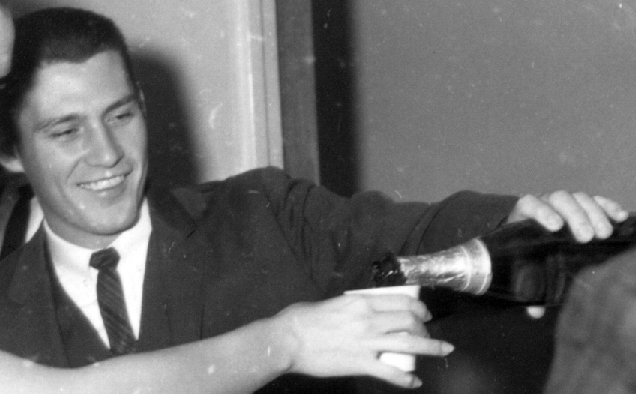
Capt Phil A Ducat
Picture of Phil Ducat at my wedding
Submitted by: Rich Granger, friend, 20061213
My husband, Edd Loftin, USMC captain, stood up for Phil and Susie Ducat’s remarriage in Pensacola in 1963. Never new Susie’s maiden name but heard after Phil’s death She had moved to somewhere in CA and we lost touch with her. Please forward any contact info you have for her if possible. marcia.loftin@gmail.com
Submitted by: Marcia Loftin, 20200731General Information
I just wanted to add that I am wearing an MIA/POW bracelet with PETER R. BOSSMAN'S name on it and for as long as I live I will never take it off nor will I ever forget. Thank you for his picture for now I can put a beautiful face to a beautiful name. My prayer is that even though his remains have never been found I hope that he is resting in peace and I pray that his family and friends have found closure.
Submitted by: Kimberlee, Bracelet wearer, Peter Bossman, 20050920Personal Narrative
I joined the Marine Corp in September of 89. My first duty station was 9th Engineers, located at Camp Hansen (right outside Kinville), where I picked up this bracelet from a POW/MIA rep at the local commissary.
Until this day I did not know the particulars about Capt Ducat, I had no idea what had happened. As I sit here trying to write this I feel hollow. I am not sure what to say and I dont know how to proceed. I can describe the braclet to you from memory as I cant tell you how many times I have sat and stared at it wondering who Capt Ducat was, what was his story in life.
I dont know how I feel about this now as I have a history and a face to go with it. I'll keep doing what I have done everyday since that time I first put the braclet on...I'll keep wearing it and wondering about who Capt Ducat was. He can never be forgotten as long as I remember.
Personal Tribute
i have been wearing Peter's MIA bracelet since 1998,it was a birthday gift from my dad,he had asked me what i wanted for my bday that year and i knew he was taking a trip to Washington,D.C. so i told him that more than anything i had always wanted a bracelet so that i can show my support.i was born 2yrs before the war ended but for some reason while i was growing up and learned all about the Vietnam War it had always intrigued me,so when he had remembered to get me a bracelet i was so excited and this bracelet has not left my wrist since,i consider this bracelet with HM3 PETER R. BOSSMAN'S name on it my most prized material possesion for reasons i can't explain and it will never leave my wrist....somehow i feel close to a man that had parrished many yrs before i was born but that doesnt matter he has become a part of me and when i am asked about my bracelet my eyes light up not just from tears but because i get to tell people all about Peter and what a true hero he is....September 25th 2010 will be his 44yr anniversary of his death,that is twice the age he was when he died and eventhough i had never had the pleasure of meeting him personally his memory will live on as long as his bracelet is on my wrist....R.I.P HM3 PETER R. BOSSMAN you may be gone but you will never be forgotten....
Submitted by: Kimberlee A Heerkens, I wear Peter R. Bossmans MIA bracelet, 20100906